

go through Terry Heck
Want to help students learn to think critically about “fake news”? A simple, browser-based game might help.
What’s the bad news? Bad News is a simple tool to help students understand the (modern?) phenomenon of “fake news,” misinformation, and “content as news” spread at least in part by the rise of digital and social media.
(You can download an information sheet for educators.)
As an interactive experience, Bad News helps students understand how fake news works, why it becomes popular, and its core mechanisms and trends. It then allows players to choose from certain fake news strategies, including emotional appeals, sarcasm, red herrings, personal attacks, and conspiracy theories.
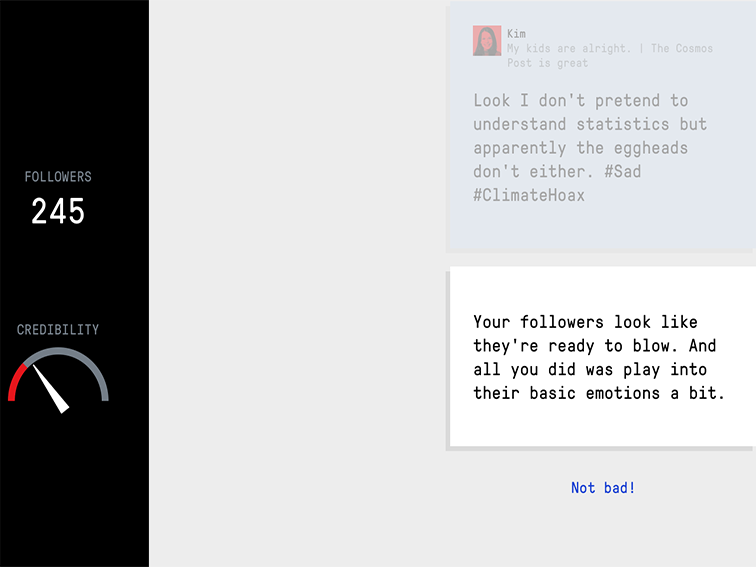
It also introduces the concept of content formats, allowing players to choose between fake news memes, Photoshopped images, or actual “content” (news reports, articles, etc.), with certain tactics (personal attacks) and formats (memes) being more effective than others depending on the fake news topic.
Compare this to our Codex of Cognitive Bias: 180 Visual Representations of Multiple Cognitive Bias You can start a crash course in critical thinking online.
Playing Bad News: Pros and Cons
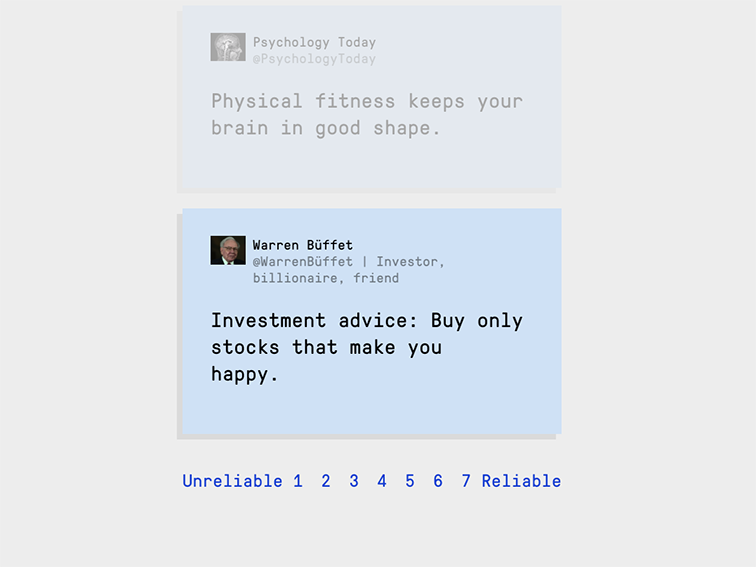
While I highly recommend the game as a teaching tool, I gave Bad News a few playthroughs and discovered a few areas where the experience could be improved—first and foremost, the “rating” mechanic that asks users to rate the reliability of certain social media posts.
While it makes sense conceptually, in practice, it’s not clear what exactly you’re assessing the reliability of: a social media post, the users who shared it, or the framing of the content in the post.

It’s also not meant to be a comprehensive simulation of learning fake news, so what you’re actually able to do is pretty thin from a mechanics perspective – which limits some usefulness, and can make it feel a bit like a lengthy finger-wagging in social media usage.
That said, when the game is at its best—making you choose between outrageous disinformation tactics in order to gain “credibility”—it’s hard not to shake your head in disbelief, because we rarely practice critical thinking in our daily lives. Fake news and social media may just be a microcosm.
The game is very simple and requires no instructions, and if the player makes a mistake, the game time is short and they can start over. As a simulation, it’s reminiscent of Plague Inc., a feeling reinforced by the Bad News developer’s stated mission to “vaccinate the world against disinformation.”
This is an excellent introductory tool if you want to introduce your students to the concept of fake news and the strategies media publishers use to change users’ perceptions of news (and thus reality itself).


