

California wildlife officials have quietly begun allowing the killing of mountain lions to protect another iconic native animal, the bighorn sheep, reversing nearly a decade of practice.
Although limited to the Eastern Sierra — the steep, rugged habitat of rare feral sheep — it marks a sea change in California, where lawmakers and voters have vigorously protected these large, charismatic cats after decades of persecution.
It’s a complex story – a lesson in ecosystems, involving three interconnected species and the struggle to do the right thing for all of them.
While some are excited, many are frustrated. Some think it’s the wrong thing to do, while others think it doesn’t go far enough to protect another beloved animal: deer.
Recent policy changes are beginning to appear. Late last year, a male lion killed several bighorn sheep in the rugged mountains of the Sierra Nevada. They put a GPS collar on him and he killed another sheep.
He was too young to start breeding or fully establish his range, so wildlife officers caught him and dragged him to what was supposed to be his new home.
But about six months later, he wandered back to Yangxiang and killed again.
They executed it this summer by lethal injection, according to Tom Stephenson, director of the California Department of Fish and Wildlife’s Sierra Nevada bighorn sheep recovery project.
how we got here
We are currently at the intersection of politics and biology. None of this would happen without an important team in the Eastern Range – the Hunters.
Last February, Brian Tillemans submitted a petition to the California Fish and Game Commission highlighting concerns about declining black-tailed deer and bighorn sheep populations in the Eastern Sierra. The local hunter, who is also a former watershed resource manager for the Los Angeles Department of Water and Power, told commissioners that the cougar population in the area has “exploded.” Hundreds of local residents signed the petition.
Brian Tillemans is a hunter and former watershed resource manager for the Los Angeles Department of Water and Power. He lives outside the town of Bishop, near Mount Tom, in the bighorn sheep region of the Sierra Nevada.
(Jason Almond/Los Angeles Times)
“The emotional biopolitics of protecting mountain lions is leading to the demise of two iconic species,” Tielemans told commissioners, his plea striking a nerve. It sparked a series of discussions that led to changes in the state’s approach to managing lions.
Mountain lions in California are a “specially protected species” and it is illegal to hunt them for sport. But under limited circumstances they can be legally killed. One is when these giant cats threaten Sierra Nevada bighorn sheep, one of two subspecies of sheep that live in the Golden State. (Another type, the desert bighorn sheep, prefers the arid Mojave Desert and the mountains of Southern California to the snowy peaks of the Sierra.)
California lawmakers gave that right to state wildlife officials in 1999, the same year Sierra Nevada bighorn sheep were added to the federal endangered species list.
In 2017, wildlife officials stopped killing lions that preyed on sheep and began relocating them, Stephenson said.
This proved successful for the lionesses and cubs. But it turns out that males that have established their own home ranges are tougher. They try their best to get back to their partner.
This will become a widely publicized failure, Two male lions from Eastern Ranges die After trucking over 200 miles to a remote area of the desert.
Bighorn seems vulnerable.

Sierra Nevada bighorn sheep began to recover after being listed as a federally endangered species in the late 1990s, but recent severe winters have reduced their numbers. In such small numbers, lions can cause serious harm to them.
(Stephen Osman/Los Angeles Times)
By the time bighorn sheep were listed under the Endangered Species Act, they had been driven to the brink of extinction due to decades of hunting and diseases spread by domestic sheep. Once protected, they start profiting. But several severe winters starting in 2016 hit the fragile population hard. In such small numbers, hungry lions can decimate a herd. Last year their total population was about 400 people.
Meanwhile, lions in the Eastern Range are doing just fine. About 70 to 80 roam the rugged hills, which Stephenson described as a “relatively large” number. They are based on wild horses roaming the areawhich may improve their ranking.
Where feasible, moving lions will remain the primary conservation tool. But because the eland’s condition is so precarious, “we recognize that we need to do everything we can to rehabilitate this animal,” Stephenson said. So lethal removal is back on the table.
John Wehausen, an applied population ecologist who has studied eland for more than half a century, is excited about the recent policy changes. He expects the bighorn sheep to start rebounding. He said data supported the effectiveness of removing lions to help sheep.
He said the agency must act quickly to relocate or euthanize the lions that were eating the sheep to prevent them from harming more people. He believes the agency was previously slow but now moves efficiently.
“I pretty much said to them, ‘I really don’t care how you get [the lions] Get out of there. You just have to protect these sheep by getting them out there in a timely manner because that’s your job,” he said.
But Beth Platt, executive director of the National Wildlife Federation’s California region, questions whether killing lions to protect sheep makes sense.
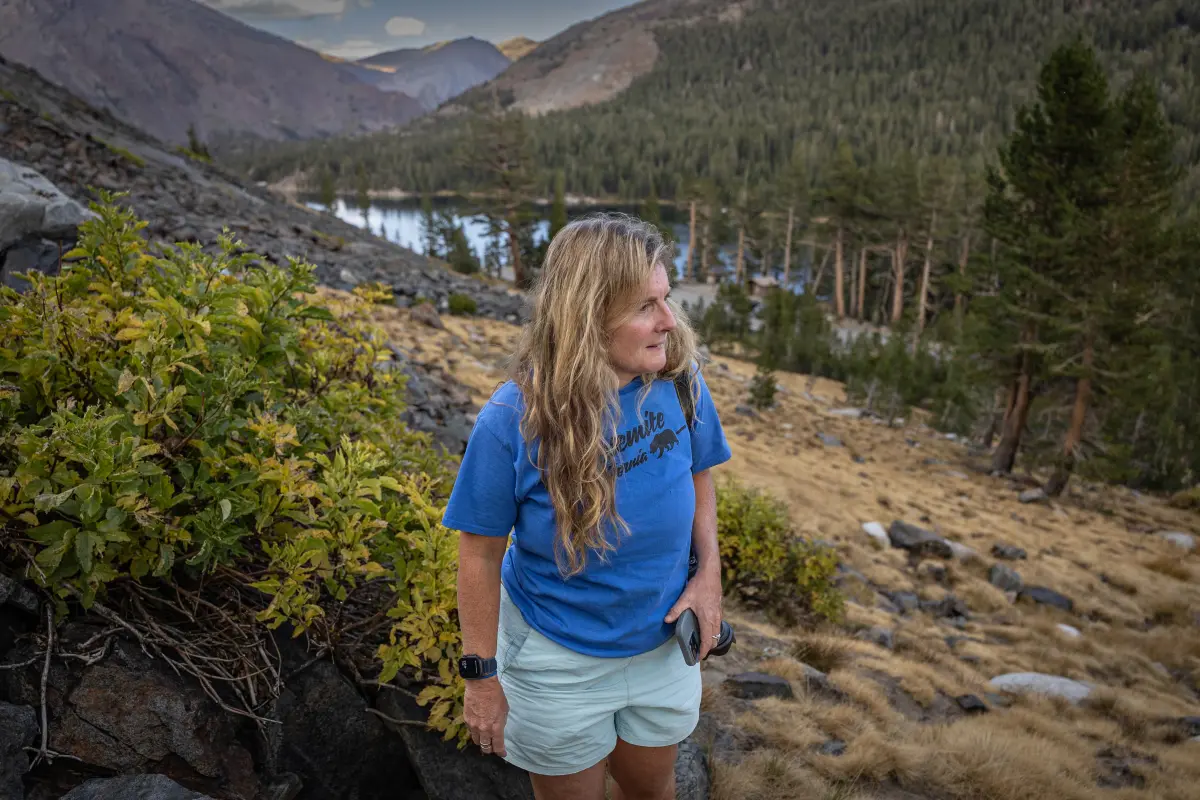
Beth Pratt of the National Wildlife Federation hikes outside the east entrance to Yosemite National Park near the town of Lee Vining.
(Jason Almond/Los Angeles Times)
“Are you constantly belittling an animal because it’s an animal when it clearly doesn’t work?” she said. Many people “understand that predators have a place in a healthy ecosystem.”
Platt wonders if there are creative solutions, such as increasing the flock’s numbers by bringing in animals raised elsewhere or placing guard dogs around the flock.
disappeared deer
For Eastern Range locals like Danny McIntosh of Bishop, deer represent a way of life. Bishop is a small community about four hours north of Los Angeles that’s popular with hunters, climbers and hikers.
McIntosh has been watching black-tailed deer since he was a kid. He was “obsessed” with bucks because bucks fight each other during mating season. In his early teens, he began photographing the animals, so named for their large, mule-like ears. He was an avid hunter and also enjoyed collecting “sheds,” the antlers dropped annually by deer and elk.
After the harsh winter of 2018, he noticed a significant decline in deer numbers, and he said the situation has only worsened.
This observation is largely consistent with findings from the state Department of Fish and Wildlife. according to Papers 2023From 2016 to 2022, the Round Valley cattle herd declined by 33%.
“What frustrates me most is that my children will never be able to experience the thriving deer herds and the many traditional activities that surround them the way I did,” McIntosh told state wildlife commissioners at a June 2024 meeting.
He places the blame primarily on lions and black bears and is unhappy with the state’s willingness to kill the big cats on behalf of bighorn sheep. While he acknowledged it would help sheep, he doesn’t expect it to have a meaningful impact on deer.
“It’s not enough,” McIntosh said. “When trapping occurs and there are no restrictions, our deer are healthiest and the herd is strongest.”
State wildlife officials have no authority to control lions for the benefit of deer.
Hunters want more deer, “and if someone can’t snap their fingers and make that happen, it’s frustrating for them,” said Stephenson, eland recovery chief for the state Department of Fish and Wildlife. “There’s a limit to how many knobs we can turn to achieve any type of rapid change. It’s a long, slow process.”
Stephenson believes it’s complicated. Yes, bears and lions eat deer. But fires can also wipe out the vegetation they depend on. Harsh winters and droughts also take their toll.
He said it’s hard to know which factors are most important in affecting a population when there are so many.
Mule deer are declining not just here, but across the West.
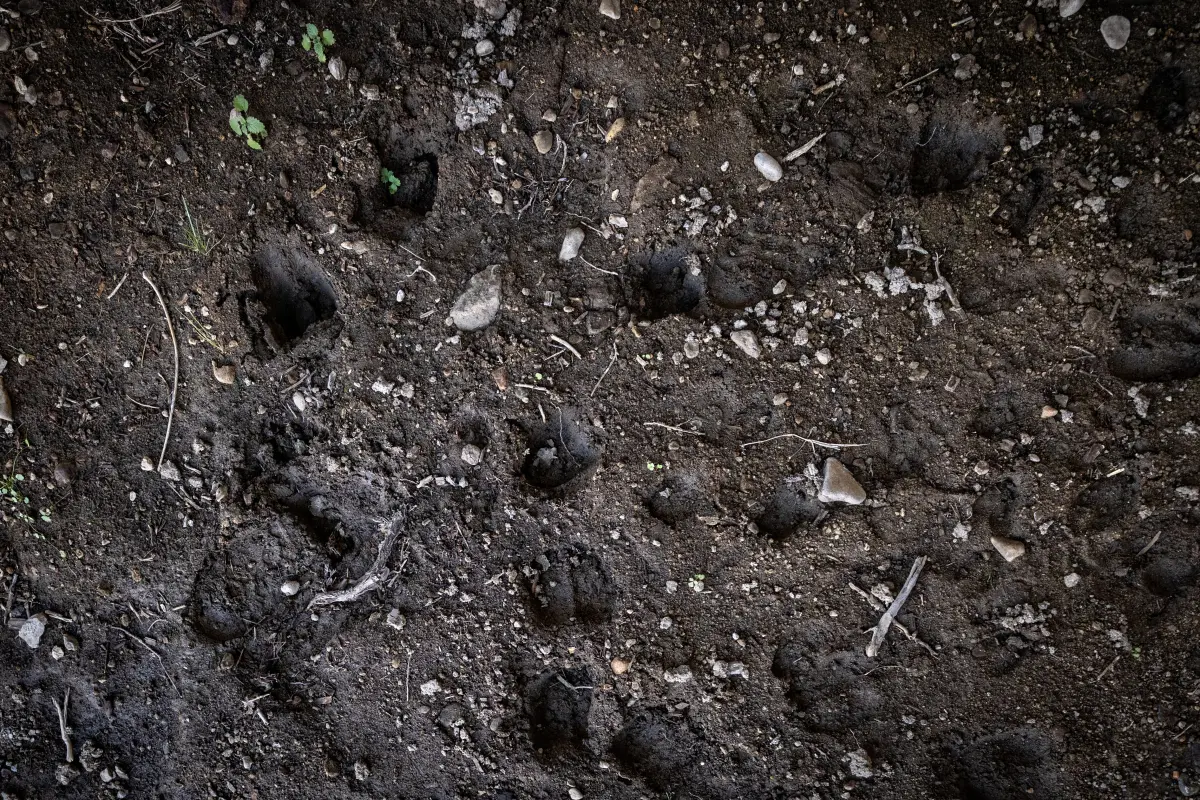
In September, the mud at a wildlife crossing under Highway 395 near Bridgeport’s East Sierra neighborhood was covered in animal tracks.
(Jason Almond/Los Angeles Times)
“We’re not worried about the deer herd here disappearing,” Stephenson said. “I think it’s a concern from the perspective of a hunter who wants hunting opportunities and has seen hunting opportunities change over the decades.”
The promise of time travel
Maybe there’s a solution everyone can get behind – one that could provide a lifeline to mule deer without knocking down lions.
Hunters and conservationists alike support building a wildlife crossing in the Eastern Sierra’s deadliest area of roadkill — the deadly stretch of Highway 395 past the Mammoth Yosemite Airport. Excluding unknown causes, car collisions are the second leading cause of death for deer.
On a sunny morning in September, a dead doe lay on the side of a trail off Route 395 as cars roared by on the main thoroughfare connecting communities along the Eastern Range.
So far, the scavengers had only torn open her back. Hunter Tielemans of Bishop, who gave a tour of the area, said that meant she had not been dead long.
From 2002 to 2018, approximately 675 vehicles were involved in collisions with deer on less than 9 miles of road. According to one person, it is right in the middle of the Round Valley and Casa Diablo cattle migration routes. recent research.
A project is underway to create safe passages for the fauna here. As envisaged, two overpasses and two underpasses will act as bridges spanning four lanes. But its future depends on raising money — lots of money. Additional planning and construction expected Spending more than $65 millionaccording to the California Department of Transportation, which is leading the effort.
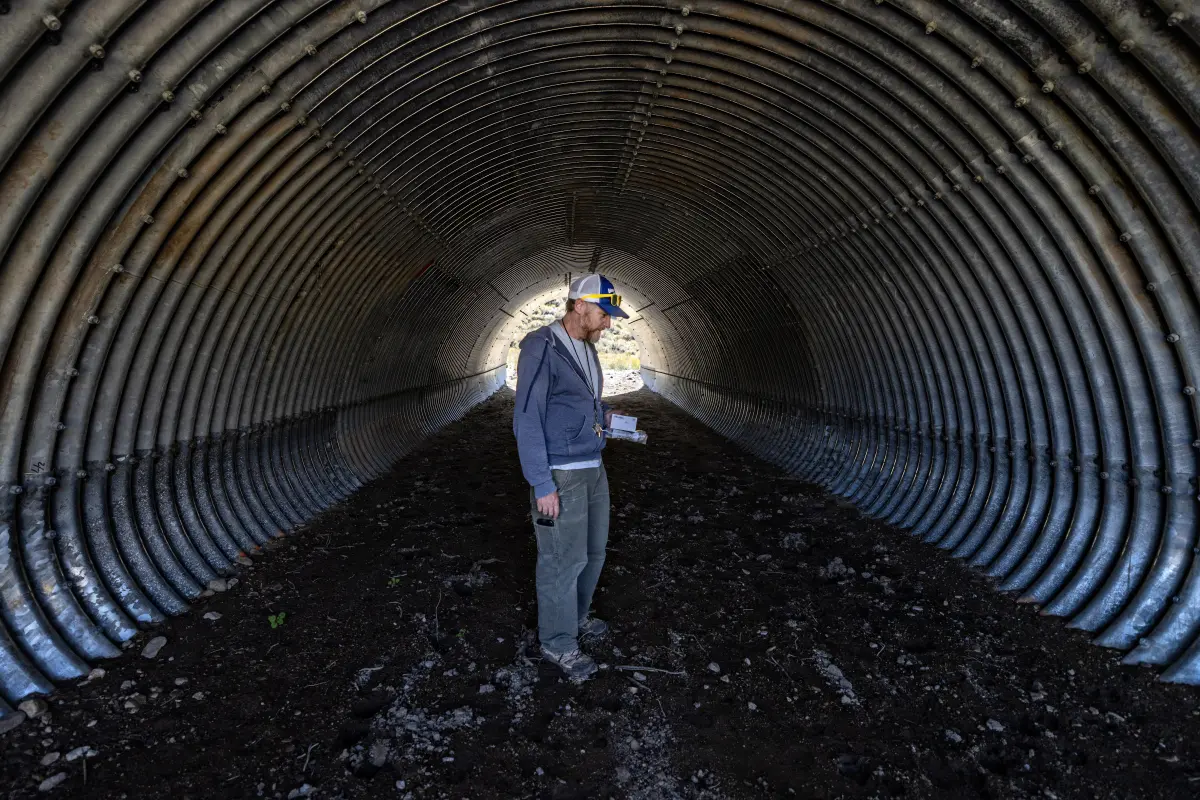
Ben Carter, a senior environmental scientist with the state Department of Fish and Wildlife, watches for signs of animals at a recently completed wildlife crossing in Bridgeport called the Sonora Junction Shoulder Project.
(Jason Almond/Los Angeles Times)
It could save countless deer lives. This may make more sense than allowing a lion hunting season as some would like. This would require a change in state law.
“If there was ever a place for deer to cross, it’s here,” Tielemans said as he drove to the proposed project area.
The recently completed crossing about 70 miles to the north may provide another example.
In early fall, Ben Carter checked out a camera installed beneath a stunning stretch of Highway 395 north of the town of Bridgeport to capture what’s going on in a corrugated metal tunnel.
Carter, a senior environmental scientist with the U.S. Department of Fish and Wildlife, pulled out the SD card for the first time to see which creatures might be early adopters of the technology. New wild animals fucked — One of two buildings built as part of the shoulder-widening project.
The tracks tell their own stories. The cloven hooves dug into the soft mud. The deer had been there.


