
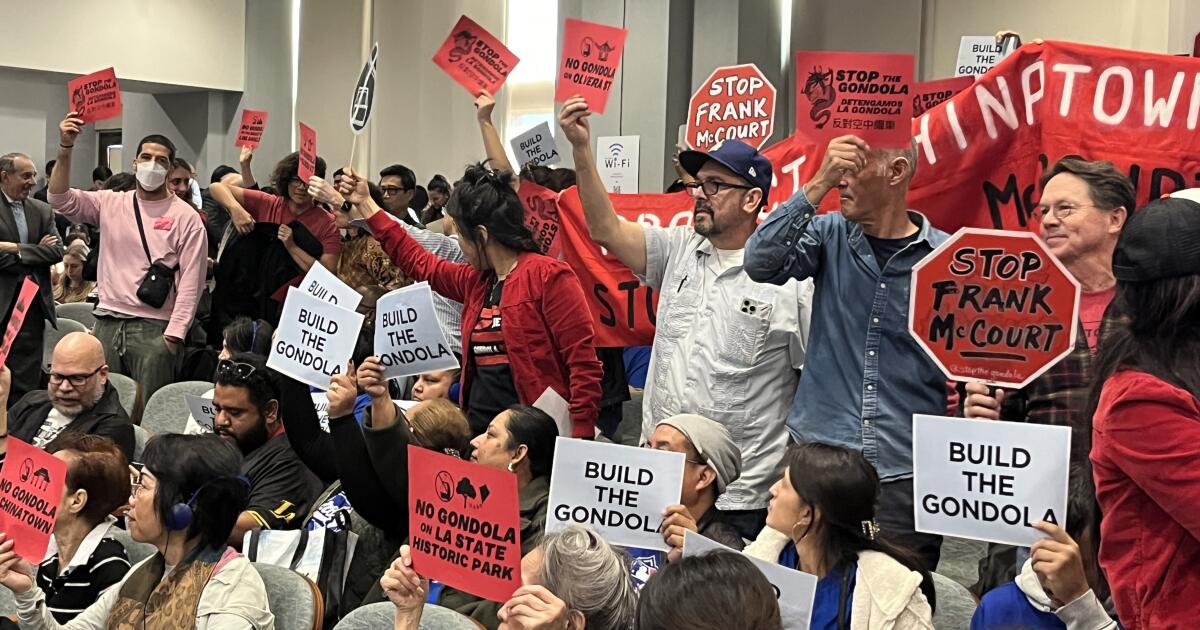
Hundreds of community members gathered in a meeting room Thursday to tell the Metro Board of Directors whether they support or oppose Frank McCourt’s proposed cable car to Dodger Stadium. The board had expressed its intention to approve the project without any discussion among directors, but then the board president announced that no community members would be heard before the vote.
This sparked an extraordinary rebellion. The public shut down the meeting, a rare act of defiance in a staid, often formulaic bureaucracy.
At the beginning of the meeting, board president Fernando Dutra explained that the public would have their say after the vote.
He was quickly inundated with chants of “Let’s talk!” The response came from anti-gondola forces and “You’ve spoken!” from pro-gondola forces, as the meeting was Metro’s fourth on the gondola and the second specifically related to the adoption of a revised environmental impact report.
Dutra tried to calm the crowd, saying, “The public will be allowed to comment at the end of the meeting.” This only infuriated the public, and the chants only grew louder and more repetitive, with Dutra threatening to have Metro officials clear the room.
The directors chose to retreat to private rooms for 75 minutes to attend to other business before deciding how to deal with a recalcitrant public.
In the conference room, slogans were heard from both sides. Antigondola’s troops bypassed the loudspeaker. Troops supporting the gondola danced around the room. More than a dozen Metro and LAPD officers stood guard between the public and the empty stands.
Directors have spoken out saying they will soften their stance. They will provide one hour for public comment before voting.
The atmosphere calmed down and the directors returned. Of the 52 public speakers, 42, including three members of the Los Angeles City Council, opposed the cable car project.
Dutra congratulated the board for coming up with the “correct process” to hear public input.
“This is what happens when you have a democratic process,” Dutra told the crowd with a straight face.
The committee tried to delay public comment until a few hours after the vote sparked the uprising, but the crowd made its voice heard, more than an hour late. Then the vote took place—and as expected, the gondola project was approved.
The gondola forces applauded. Antigondola’s troops again shouted: “Shame on you!”
Next step? How much?
Artist’s rendering of a potential cable car to Dodger Stadium.
(Courtesy Air Rapid Transit Technologies/Kilograph)
As Metro certifies a revised environmental impact report, state agencies and the Los Angeles City Council will consider whether to approve the cable car project. The commission is unlikely to begin work on the project before the end of next year after receiving a study evaluating traffic and congestion relief options around Dodger Stadium.
The environmental impact report estimates construction costs in 2023 at $385 million to $500 million. Construction costs will only rise, and a project spokesman did not provide an updated cost estimate this week.
Metro’s preliminary approval in 2024 requires Metro staff to work with the organization responsible for getting the gondolas up and running to “provide quarterly updates to Metro’s board of directors on project progress and financing.”
A Metro spokesperson said the updates “have not been released because work on the project is paused pending litigation.”
Thursday’s approval means the proceedings are over, so updated cost estimates should be released in the spring. The project has been committed to private financing, but no financing agreement has been publicly disclosed.
Bath speaks
The City Council voted 12-1 last month to pass a resolution urging Metro to kill the cable car project. The resolution was presented to Mayor Karen Bass, but she neither signed nor vetoed it.
The resolution was sponsored by three council members from districts closest to Dodger Stadium.
“The feeling of the council is important to me,” Bass told The Times. “But if one member of the constituency is passionate about a project, other members will support it.
“There’s more time to work things out. I just don’t feel like it’s appropriate to stop this now.”
Councilwoman Eunisses Hernandez, whose district includes Dodger Stadium, said she has been working to gain support from her council colleagues and offer them alternatives to the gondola when the council is expected to vote on the project next fall.
“After a year, you’ll see results,” Hernandez said. “I hope my colleagues will see this and continue to help us move in this direction.
“I hope people take seriously what the committee says. Getting a 12-1 vote on any issue, especially an issue like this, is not an easy thing to do. This is a big deal.”
Bass said she wants to explore how communities can use the gondola to address community priorities.
“Overall, my interest in this project is the community benefits – most notably the potential benefits to the area around Homeboy Industries and Chinatown. I am very saddened by the deterioration of the Chinatown I grew up knowing,” she said.
“There are groups advocating for more resources to be put there and for Frank McCourt to do more to develop, rebuild and revitalize Chinatown.”


